Code Wheels Archive of restored copy protection
Classic Video Game Copy Protection Code Wheels Digitised and Accessible Online
On this little retro gamer's side project website you can find our digitised collection of code wheels from original boxed old games, accessible online and interactive. All of them spin independently with a mouse click and drag or with the keyboard arrow keys, and they work in all modern browsers. Several code wheels contain two or three independent layers and you can choose which one to rotate. On each code wheel page we bring interesting information about the particular copy protection or detailed instructions on how to use it while playing the game. We are still looking for gamers, collectors and contributors willing to provide scans of their original physical copy of any interesting code wheel...

Star Control
Star Control
The Secret of Monkey Island - Dial A Pirate
Secret of Monkey Island, The
Monkey Island 2 - Mix N Mojo
Monkey Island 2: LeChuck's Revenge


Another World
Another World
Cruise for a Corpse
Cruise for a Corpse
Pool of Radiance - Translation Wheel
Pool of Radiance
Hillsfar - Translation Wheel
Hillsfar
Curse of the Azure Bonds - Translation Wheel
Curse of the Azure Bonds
Elvira 2: The Jaws of Cerberus
Elvira II: The Jaws of Cerberus
Waxworks
Waxworks
Hero Quest 2: Legacy of Sorasil
HeroQuest II: Legacy of Sorasil


Legacy of the Ancients
Legacy of the Ancients
Indiana Jones and the Fate of Atlantis - Action
Indiana Jones and the Fate of Atlantis: The Action Game


Pipe Dream
Pipe Mania
Neuromancer - PAX Verification Code Wheel
Neuromancer
HardBall III - Code Wheel
HardBall III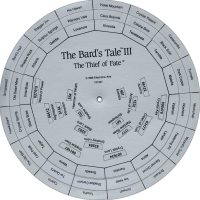
Bard's Tale 3: Thief of Fate
Bard's Tale 3: Thief of FateAbout Code Wheels
A code wheel is a type of copy protection used on older computer games, often those published in the late 1980s and early 1990s. It evolved from the original "manual protection" system in which the program would require the user to enter a specific word from the manual before the game would start up or continue beyond a certain point. This system was popular because it allowed the actual media to be backed up and replaced freely while retaining security, but with the increased availability of photocopiers, those wishing to distribute the games simply started copying their manuals as well to defeat the measure.
Although whole code wheels could not be directly photocopied, the component wheels could be disassembled and individually photocopied; these components could then be crafted together into a duplicate wheel. The contents of code wheels could also be copied onto paper and the user of an unlicensed copy could simply apply a mathematical formula to the presented challenges to calculate the correct response. Once a suitable formula was found, code wheels actually made the process of copying easier since the amount of information they could contain was low compared to a manual of potentially unlimited size. Thus, code wheels were rapidly phased out in favour of regular manual protection and protection based around colour, as public access to colour photocopying at the time was expensive and uncommon. This was itself made obsolete by a return to protection based on the game media itself, when CD-ROMs were introduced.
Code wheel forms
A code wheel itself is a physical object consisting of several circular sheets of paper or card of different sizes, fastened in the centre, creating a set of concentric circles. The game issues the user with a set of challenges (symbols, words or other identifiers), which instruct the user in how to manipulate the wheel in order to reveal a response: a single symbol or word that the user must enter in order to start the game. Entering anything other than the expected response would result in the game halting or performing other behaviour associated with unauthorised usage of the software (for example, the game Starflight would send unbeatable "police ships" to destroy the player's spaceship).