Dungeons & Dragons: Tower of Doom 1994
Description 29.11.2026
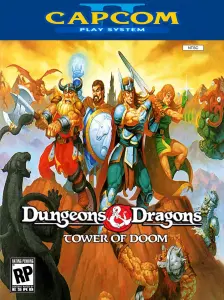
The first of 2 Dungeons & Dragons arcade games was built by Capcom on its CPS2 board and reached Japanese arcades in January 1994, North America and Europe later that year. TSR owned the brand and Capcom licensed it through SSI, as the game announces on its opening screen. The operator's manual carries a 1993 copyright. Up to 4 players share the cabinet, and the classic beat-em-up gets the kit of a tabletop RPG: spells, an inventory, shops and forks in the road.
The Republic of Darokin in the world of Mystara is overrun by orcs, goblins, kobolds and worse. Four adventurers first defend the surrounding villages, then take a job from the merchant Corwyn Linton to find out who is organising the raids. The trail leads to the arch-lich Deimos and his Tower of Doom.
Gameplay
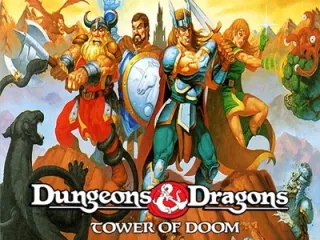
The 4 characters match the classes of the pen-and-paper game: the fighter Crassus has the most hit points, the elf Lucia a weaker sword but 7 spells from Magic Missile to Cloudkill, the cleric turns undead, knows 5 spells and blocks best, and the dwarf is the fastest in close combat. Besides attack and jump there are blocks, turning and dashing attacks, crouching and evading, and 2 of the 4 buttons belong to the inventory: daggers, hammers, arrows, flasks of burning oil and magic rings that cast spells. Between levels the party spends silver in shops, and players can share it among themselves. At forks the party picks its route, and one run never covers the whole adventure.
The traps come straight from the rulebook: trap floors, illusory walls, surprising chests and saving throws, where frantic waggling of the joystick decides whether a character gets burnt or turned to stone. So the dice are still rolled by hand, just differently. The bosses are bestiary regulars: a manticore, a beholder, a black dragon, the Shadow Elf, the optional red dragon Flamewing and finally Deimos.
Reception and legacy
GamePro 57 (April 1994) gave the game 2 pages in its RPG column. It praised the depth, the branching routes, the traps and monsters that looked lifted from Larry Elmore's and Jeff Easley's art, and criticised action that is slower than it could be and swordplay that sometimes feels sluggish. In its words the game drains quarters faster than a lich drains levels. Capcom followed it in 1996 with Shadow over Mystara. Both games came out in Japan in 1999 on the Sega Saturn as Dungeons & Dragons Collection (2 players only, with a 4 MB RAM cartridge). In 2013 they were reissued worldwide as Chronicles of Mystara for PlayStation 3, Xbox 360, Wii U and Windows.
The story outline was written by Alex "Raven" Jimenez of Capcom USA, who first ran it as a tabletop adventure for his gaming group in San Jose. The Japanese team then adjusted the design based on their reactions. The export version offers English, Spanish, French, German and Italian, but the language is chosen by the arcade operator in the service menu, not by the player.