Rock-Ola's Nibbler 1982
Description 28.11.2026
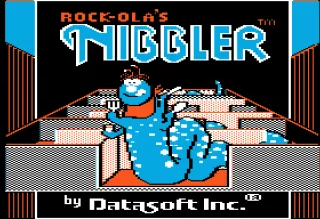
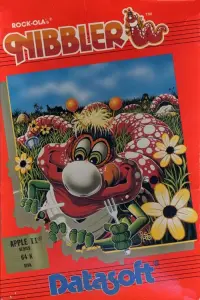
Rock-Ola, a company the world knew mainly for its jukeboxes, also built video games at the start of the eighties, at first other firms' titles made under licence. Nibbler from 1982 is one of its own: a maze arcade game in which a snake grows with every bite, as in Blockade, but travels the corridors of a maze like Pac-Man. It went down in history for its 9-digit score counter, which made it the first game in which a billion points could be scored. Datasoft took the home computer licence and released versions for the Atari 8-bit and the Apple II in 1983. The Amstrad CPC got a separate game with the same name and idea from Rainbow Arts in 1985, written by Rolf Lakaemper.
Gameplay
Each wave asks the player to eat every object in the maze before the time runs out. The player only picks the direction: the snake moves by itself and does not stop at corners, so a moment of hesitation at a junction ends in a dead end or in its own body. There are no enemies. A life is lost only by biting the snake's own tail or by running out of time, and the clock runs faster while the snake eats nothing. The snake therefore grows at exactly the rate its free space shrinks. Time left over becomes a bonus at the end of the wave, every 4 waves add a life, and the player sees every maze only after wave 32, after which the game carries on at maximum difficulty.
The Datasoft versions (Mark White programmed the Atari one with graphics by Joe Pearson, Kevin Furry the Apple II one) keep the arcade rules: points per object rise with the wave number from 10 to 50, the time left is multiplied by the wave number and 2 players take turns. The Rainbow Arts game changed the rules its own way and added a fairy tale: a cruel witch in the deep woods of Relbin turned everyone who came too close to her house into a strange creature called a wurpel, and the way back leads through a magic garden of 9 parts. Up to 4 people can play, the text is English or German, and owners of a green monitor get a mode of their own. Here the snake waits until it is given a direction, which is not safe either: wait too long and a life is gone.
The 9-digit counter was not there for show. In January 1984, at the Twin Galaxies arcade in Ottumwa, Iowa, 17-year-old Tim McVey took it to 1,000,042,270 points after about 44 hours of play and became the first player to score a billion in a video game. The record changed hands several times after that, and McVey's attempt to win it back in 2011 is the subject of the documentary Man vs Snake: The Long and Twisted Tale of Nibbler (2015).