NBA Showdown 1993
Description 28.11.2026
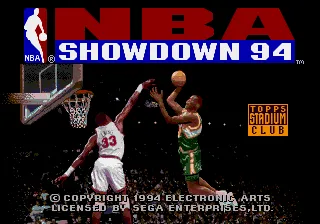
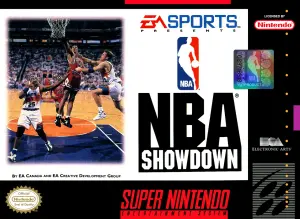
Electronic Arts released the basketball game NBA Showdown under its EA Sports label for the SNES in October 1993, followed a few months later by NBA Showdown '94 for the SEGA Genesis. It succeeds Bulls vs Blazers and the NBA Playoffs and is the last basketball game on the engine introduced by Lakers versus Celtics and the NBA Playoffs, as well as the first of them to offer all 27 NBA teams. The SNES version was made by the Electronic Arts Canada team in Vancouver, while the Genesis version was programmed by Lisa Ching, who had worked on the earlier games, with Mark Phoenix and Paul Shaw. The SNES version pays tribute to the 1993 Finals between the Chicago Bulls and the Phoenix Suns, yet this time the finalists stayed out of the title, surviving only in the subtitle of the Japanese Super Famicom release.
Gameplay
The SNES version has the 27 teams of the 1992-93 season plus the East and West All-Stars. Players choose a pre-season game, a full season with a calendar, trades and league leader boards, or go straight to the playoffs, and the battery in the cartridge keeps up to 3 seasons in progress. Games the player would rather skip are simulated from the real team statistics. Arcade mode has no fatigue or fouls, but simulation does, and an injured player can miss up to 7 games. Whether a shot goes in depends on the shooter's stats, his type, the distance of the defender and the shooter's health. The stars have their own "marquee" moves, and free throws are aimed with the T-Meter. Players go through hot and cold streaks, and a team on a long winning run tends to stumble. The Custom Team Builder assembles 2 custom squads from the starting fives of every team, so Michael Jordan can end up guarding himself. Commentators Ron Barr and K. C. Darty cover the game before tip-off, at halftime and after the buzzer.
NBA Showdown '94 for the Genesis is a richer game developed separately. It uses the 1993-94 rosters, with rookies such as Chris Webber and Toni Kukoč, supports up to 4 players with the 4 Way Play adapter and offers seasons of 26 or 82 games. New are offensive and defensive play calling, defensive match-ups, 12 ratings per player in the Topps Skills Rating System and an Arcade Custom mode in which the player switches off fouls, travelling or time violations. Jordan, who retired in October 1993, is gone: the team introduction has the Bulls playing "despite losing their leader" with the pride of the defending champions.
Reception and legacy
The British Total! 27 gave the SNES version 50 %, calling it a reworked Bulls vs Blazers with the same tedious gameplay, imprecise controls and a sluggish pace. Mean Machines Sega 18 also found the Genesis version slow, measured it against the arcade-style NBA Jam and faulted it for caring more about rules than fun. It was followed by NBA Live 95, made by Electronic Arts Canada, which launched the NBA Live series.
The SNES manual opens with tongue-in-cheek developer profiles written like a team roster. Programmer Doug Smith, it says, left for another software company in mid-development "for no future considerations at all", and composer Traz Damji is introduced with the assurance that his name is not an anagram of Kareem Abdul-Jabbar.